
Reviews
The Golden Hour: How Point-of-Injury Care is Adapting to Modern Global Emergencies

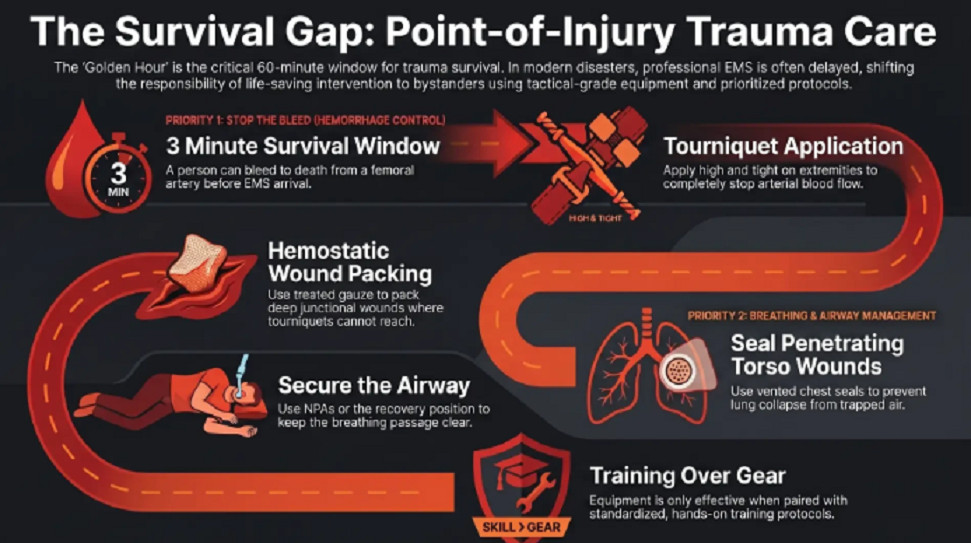
In trauma medicine, the “Golden Hour” refers to the critical sixty-minute window immediately following a traumatic injury. Medical professionals widely agree that if a critically injured patient receives definitive surgical care within this timeframe, their chances of survival increase exponentially. However, the modern reality of global emergencies is rapidly rendering the traditional expectation of swift ambulance arrivals obsolete.
From the shifting frontlines of international conflicts to the catastrophic infrastructure collapse seen in recent global natural disasters—such as the events detailed in BNO News reports on the devastating Turkey-Syria earthquake—the logistics of emergency response have fundamentally changed. Roads become impassable, communication networks fail, and local Emergency Medical Services (EMS) are instantly overwhelmed. In these chaotic environments, the timeline for professional medical intervention stretches from minutes to hours, or even days.
During large-scale emergencies or unpredictable crises, professional medical personnel are often stretched thin, drastically increasing response times. In these high-stakes scenarios, the gap between injury and professional care must be bridged by bystanders equipped with adequate tools. This reality has driven a significant shift in public safety protocols, with safety experts now emphasizing the necessity of having quick access to a comprehensive Rhino Rescue Individual First Aid Kit (IFAK) that includes trauma-grade tourniquets, chest seals, and hemostatic dressings, rather than relying solely on traditional, low-acuity first aid supplies.
The responsibility for initial trauma care has irrevocably shifted toward the point of injury. Civilians, journalists, and first responders must now operate under the assumption that they will be their own first medical resource. This paradigm shift requires a new standard of equipment and a fundamental misunderstanding of what basic life support looks like in the 21st century.
The Anatomy of Modern Trauma Preparedness
For decades, civilian first aid focused primarily on minor abrasions, basic CPR, and stabilization while awaiting professional help. Today, modern trauma preparedness is heavily influenced by protocols developed on the battlefield, specifically the Tactical Combat Casualty Care (TCCC) guidelines. These protocols prioritize interventions based on the most statistically preventable causes of death in trauma scenarios.
The transition from a standard “Band-Aid” approach to a trauma-focused mindset requires an understanding of the physiological realities of severe injury. Modern trauma kits are designed not for comfort, but for absolute survival. They strip away the unnecessary and focus exclusively on stabilizing life-threatening conditions until evacuation is possible.
This streamlined approach relies on evidence-based medicine. According to the World Health Organization’s data on trauma and injuries, millions die annually from preventable traumatic injuries, many of which occur in environments where immediate professional care is unavailable. Addressing these statistics requires a specific hierarchy of point-of-injury interventions.
Hemorrhage Control as the First Priority
In any high-velocity trauma or crush injury, exsanguination (severe blood loss) is the leading cause of preventable death. A human adult can bleed to death from a severed femoral artery in less than three minutes, long before even the fastest urban EMS can arrive. Therefore, modern trauma care dictates that controlling massive hemorrhage is the absolute first priority at the point of injury.
This requires specialized, medical-grade equipment designed for rapid deployment. Traditional gauze and direct pressure are often insufficient for arterial bleeds. Key interventions include:
- Tourniquet Application: Using a commercially produced, windlass-style tourniquet placed high and tight on the extremity to completely occlude arterial blood flow.
- Wound Packing: Utilizing hemostatic agents (gauze impregnated with blood-clotting compounds) to pack deep junctional wounds where tourniquets cannot be applied, such as the groin or axilla.
- Pressure Dressings: Applying engineered trauma dressings that provide continuous, focused mechanical pressure on the wound site to maintain clot integrity during patient transport.
Airway and Respiratory Management
Once massive bleeding is controlled, the secondary focus shifts to the respiratory system. Penetrating trauma to the torso can severely compromise lung function, leading to a condition known as tension pneumothorax. This occurs when air enters the chest cavity but cannot escape, eventually collapsing the lung and putting fatal pressure on the heart.
Managing these specific trauma profiles requires interventions that go beyond traditional CPR protocols. Responders must be equipped to seal the respiratory system from outside air while maintaining an open anatomical airway. Essential steps and gear include:
- Vented Chest Seals: Adhesive, occlusive dressings applied over penetrating chest wounds. The built-in vents allow trapped air to escape the chest cavity while preventing ambient air from entering during inhalation.
- Nasopharyngeal Airways (NPA): A flexible tube inserted through the nasal passage to secure an open airway in semi-conscious or unconscious patients, preventing the tongue from occluding the throat.
- Positioning: Placing the stabilized patient in the recovery position to prevent airway obstruction from blood or emesis when advanced airway adjuncts are unavailable.
Bridging the Gap Between Civilians and Tactical Medics
Historically, the advanced medical equipment discussed above was the exclusive domain of military medics, SWAT teams, and specialized rescue units. However, the unpredictable nature of modern crises has erased the geographical boundaries that once separated “safe zones” from disaster areas. We see this acutely in ongoing BNO News coverage of mass casualty incidents across various urban centers worldwide.
Because violence and catastrophic accidents can occur in schools, shopping centers, and office buildings, the demographic requiring tactical-grade trauma gear has fundamentally expanded. Teachers, conflict journalists, and corporate security personnel are increasingly adopting the gear loadouts once reserved for the military. This civilian adoption is not an overreaction; it is a calculated, necessary response to prolonged EMS response times in “hot” zones.
Furthermore, the design of trauma equipment has evolved to accommodate this broader user base. Manufacturers are focusing on intuitive deployment mechanisms, high-visibility instructions, and packaging that can be opened under extreme duress. The goal is to ensure that a panicked civilian with minimal training can successfully deploy a life-saving device under catastrophic conditions.
The Importance of Standardized Training and Public Awareness
Possessing a state-of-the-art trauma kit is ultimately useless—and potentially dangerous—if the user lacks the training to apply the equipment correctly. An improperly applied tourniquet can cause compartment syndrome or fail to stop an arterial bleed, while an incorrectly packed wound will simply continue to hemorrhage internally. Knowledge is the critical multiplier for any physical trauma gear.
Equipment alone cannot save lives; the determining factor is the rapid, competent application of that equipment by those closest to the point of injury. Recognizing this, major medical institutions and government bodies have heavily invested in bystander education. Programs like the national Stop the Bleed campaign have been instrumental in training everyday civilians to recognize life-threatening hemorrhage and intervene effectively, turning potential victims into immediate responders during the most critical moments of a crisis.
These standardized training initiatives demystify trauma care. They rely on simple, repeatable algorithms (such as the MARCH protocol) that bypass complex medical diagnostics in favor of immediate, life-saving action. By institutionalizing this training in corporate environments and public schools, society is effectively crowdsourcing emergency medical response.
Key Takeaways
| Area | Key Takeaway | Impact/Data |
| EMS Status | Assume zero immediate EMS support | Response delayed by hours or days |
| Blood Loss | Prioritize immediate arterial bleed occlusion | Prevents death in < 3 minutes |
| Trauma Gear | Deploy tactical-grade trauma kits (IFAK) | Survives injuries standard kits cannot |
| Airway Mgmt | Apply vented chest seals quickly | Stops fatal tension pneumothorax |
| Staff Training | Mandate “Stop the Bleed” certification | Converts bystanders into immediate responders |
Conclusion: A Shift Towards Proactive Survival
The concept of the “Golden Hour” remains a cornerstone of trauma medicine, but the methodology for achieving survival within that window has irreversibly changed. The realization that professional medical help will likely be delayed during a mass casualty event or natural disaster places the burden of initial survival squarely on the shoulders of the public.
Adapting to modern global emergencies requires a proactive approach to personal and community safety. This involves discarding outdated notions of first aid in favor of evidence-based trauma care, investing in professional-grade point-of-injury equipment, and committing to standardized hands-on training.
Ultimately, preparedness is no longer just an occupational requirement for tactical professionals; it is a vital civic responsibility. By understanding and embracing the realities of modern trauma care, individuals can effectively bridge the deadly gap between injury and definitive medical treatment, ensuring that the critical “Golden Hour” is not lost to simply waiting for help to arrive.


Journalist shot dead in Mexico after blaming state government for death threats

Mexican mayor shot dead inside city hall

10 members of same family, including 5 children, killed in house fire in Peru

Houthis claim missile and drone attacks on 2 Saudi oil tankers in Red Sea
-

 Politics1 week ago
U.S. sanctions 10 Cuban entities over repression and regime funding
-

 Legal1 week ago
Muslim mall worker critically injured in stabbing over his religion
-

 Legal2 days ago
Sinaloa Cartel leader ‘El Mayo’ sentenced to life in U.S. prison
-
 Legal1 week ago
Austin police release footage of fatal shooting of man who pointed gun at bystanders
-

 Legal1 week ago
New Mexico detective convicted of helping drug trafficker evade DEA operations
-
 Legal6 days ago
Marine veteran charged with threatening to kill Trump in ‘holy war’
-

 Legal1 week ago
New York man arrested after livestreaming threats to kill Donald Trump Jr.
-
 World1 day ago
Death toll from Guyana ferry disaster rises to 53