
Reviews
What Is AI Security and Why Does It Matter for Regulated Industries?


Banks, hospitals, insurers, and government agencies are adopting artificial intelligence as fast as anyone, but they carry a burden most companies do not: strict rules about how sensitive data is handled. That combination raises an urgent question about AI security, and about why it carries far more weight here than almost anywhere else. The short answer is that it protects AI systems plus the information they touch, and in regulated sectors a lapse means not just a breach but fines and legal exposure. The stakes are already visible: IBM’s 2025 Cost of a Data Breach Report put the average healthcare breach at 7.42 million dollars, the costliest of any industry for the fourteenth year running. Regulators are watching that number, and a new wave of AI-specific rules is arriving on top of the ones these firms already follow. This guide explains the field and why compliance-bound teams cannot treat it as optional.
Key Takeaways
- AI security protects AI systems along with the sensitive data they process, then governs how AI is used.
- Regulated sectors carry the heaviest breach costs, led by healthcare at over 7 million dollars per incident.
- New rules such as the EU AI Act add duties on top of GDPR, HIPAA, and financial regulations.
- IBM found that 97% of organizations breached through AI lacked basic access controls.
- Governance, strict access, and clear audit trails form the core of a compliant program.
AI Security, Defined
Before weighing tools or policies, leaders have to answer a basic question, what is AI security? At its core, it is the practice of protecting artificial intelligence systems, their training data, models, and outputs, from attack, while controlling how the technology is used so sensitive information stays contained. For regulated organizations, that second half carries legal weight, because the same data an attacker wants is the data a regulator expects you to safeguard.
It spans two related jobs: defending the AI you build or buy, and using AI to strengthen your wider defenses. In a regulated setting, both also have to produce evidence that the controls are actually working. That evidence, not the protection alone, is what turns AI security into a compliance asset.
Why Regulated Industries Have the Most to Lose
Regulated industries hold the data attackers prize most: medical records, account details, claims, and identity information that stays valuable for years. They also answer to regulators who impose fines when that data is exposed. The result is the highest breach costs of any sector.
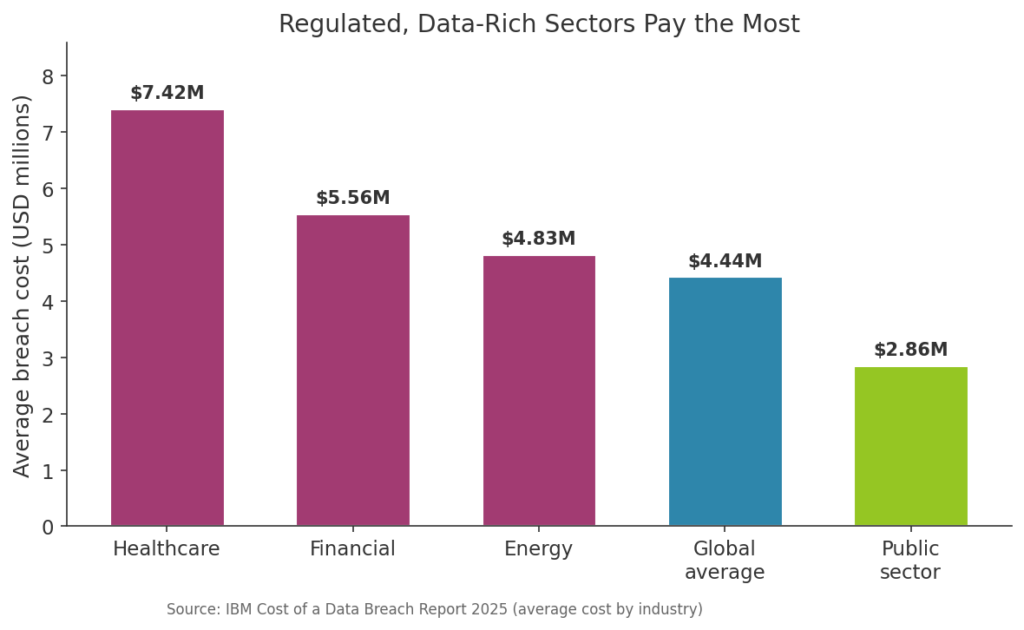
The pattern is consistent. Healthcare has topped the list for well over a decade, driven by protected health information and slow detection, while financial services follow close behind because of regulatory penalties and fraud liability. The same care that shields people when protecting data on public networks is what regulators now expect around AI systems too. A single exposed database can trigger regulatory notifications across several jurisdictions at once, each with its own clock and its own penalties.
The Rules Are Catching Up to AI
For years, AI outran the law. That gap is closing fast. The European Union’s landmark regulation takes a risk-based approach, placing the strictest duties on high-risk uses, and its penalties reach as high as 35 million euros or 7% of global turnover.
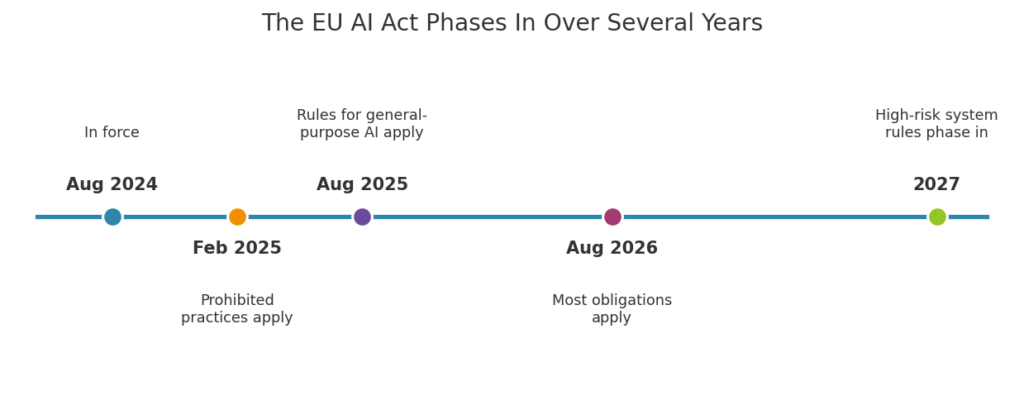
It does not replace existing law; it stacks on top of it. The table below shows the main rules regulated organizations must now weigh together.
| Regulation | Applies to | What it means for AI |
|---|---|---|
| EU AI Act | AI used in or affecting the EU | Risk-based obligations, transparency, and heavy fines |
| GDPR | Personal data of EU residents | Lawful, transparent processing, including by AI |
| HIPAA | US protected health information | Safeguards for any AI touching patient data |
| DORA | EU financial entities | Operational resilience for AI-driven systems |
| SEC and FINRA rules | US financial firms | Record-keeping and disclosure for AI decisions |
For the full scope of the European framework, regulated teams increasingly consult Europe’s risk-based AI rules directly rather than relying on second-hand summaries. Similar moves are underway elsewhere, from sector regulators issuing AI guidance to national laws taking shape, so the compliance map will only grow more detailed.
Where AI Security and Compliance Collide
In a regulated context, an AI security failure is usually a compliance failure as well. Several risks map almost directly onto legal exposure.
| AI security risk | Compliance exposure |
|---|---|
| Sensitive data leakage | GDPR or HIPAA violations and mandatory breach reporting |
| Shadow AI | Uncontrolled data processing outside any written policy |
| Biased or opaque outputs | Discrimination claims and high-risk AI obligations |
| No audit trail | Failure to meet record-keeping and accountability duties |
| Unvetted AI vendors | Third-party liability that regulators pass back to you |
| Warning: shadow AI is a particular trap. When staff paste confidential records into unsanctioned tools, the data leaves your controlled environment entirely, and under most regimes that alone is a reportable event. |
“Ungoverned AI systems are more likely to be breached, and more costly when they are.” IBM, 2025
These pressures are sharpest wherever AI shapes decisions, from lending to diagnostics, which is also where the questions AI training data raises become legal as much as ethical. The safe assumption is that any AI handling regulated data will eventually be audited, so building for that day from the outset avoids a painful retrofit later. In practice, that means designing controls that can be evidenced, not merely switched on.
What Regulated Organizations Should Do
The path forward is demanding but clear. A compliant AI security program rests on a few pillars, each mapping back to a rule someone will eventually check.
- Govern first: assign ownership, write an AI use policy, and inventory every model and tool.
- Control access tightly, treating each model and AI agent as an identity with least-privilege rights.
- Protect the data pipeline end to end, with classification, encryption, and clear consent.
- Log everything, so you can show an auditor what the AI did and why.
- Vet vendors, since their weak controls quickly become your regulatory problem.
Access sits at the center of most requirements, so applying tightly governed access controls to AI systems answers security and compliance at once. Even in tightly regulated corners like the fast-moving world of options trading, the leaders pair innovation with controls rather than choosing between them. Getting access right early also makes every later control far easier to prove.
| Key stat: the investment pays back. Organizations that use AI extensively in their own defenses save close to 1.9 million dollars per breach and contain incidents about 80 days faster, according to IBM. |
[Video: “Securing & Governing Autonomous AI Agents: Risks & Safeguards” by IBM: https://www.youtube.com/watch?v=E_yPUsCpoC8]
This short explainer covers how to secure and govern the AI agents that regulated workflows increasingly depend on. None of these pillars is exotic; they are familiar security disciplines applied deliberately to AI and documented for auditors.
| Pro tip: map each AI control to the specific regulation it satisfies. That single step turns a security project into audit-ready evidence and saves enormous effort when regulators ask how you manage AI risk. |
Frequently Asked Questions
What does AI security mean in simple terms?
It is protecting AI systems and the data they use from attack, while overseeing how AI is deployed. In regulated industries it also means proving that those protections meet legal requirements.
Why is it more urgent in regulated industries?
Because these sectors hold the most sensitive data and sit under regulators who levy fines. A breach brings not only recovery costs but penalties, which is why healthcare and finance top the breach-cost charts.
Does Europe’s AI Act reach companies outside the bloc?
Often, yes. Like GDPR, it can reach organizations whose AI systems are used in or affect the EU, wherever the company is based. Many global firms are aligning to it as a baseline.
What is the biggest AI compliance risk?
Data leakage and shadow AI lead the list. Both move regulated data outside controlled systems, which can trigger breach-reporting duties and fines under GDPR, HIPAA, and similar regimes.
Where should a regulated organization start?
Start with governance and access. Inventory every AI system, apply least-privilege controls, and log activity. Those steps close the most common gaps and produce the evidence auditors expect.
Compliance Is the Price of Admission
For regulated industries, AI security is where innovation meets obligation. The technology promises faster service and sharper decisions, yet the data behind it is exactly what the law protects most fiercely. The organizations that will use AI with confidence are the ones that build governance, access control, and audit trails from the start, rather than bolting them on after a regulator calls. Define what you are protecting, learn the rules that now apply, and secure the data first. The rules will keep tightening, and the teams that prepare will adapt with far less pain. In regulated sectors, that discipline is not a luxury; it is simply the cost of doing business.
References
European Commission, Regulatory Framework on Artificial Intelligence (EU AI Act). https://digital-strategy.ec.europa.eu/en/policies/regulatory-framework-ai
IBM, Cost of a Data Breach Report 2025. https://www.ibm.com/reports/data-breach
IBM Think, Cost of a Data Breach: The Healthcare Industry, 2025. https://www.ibm.com/think/insights/cost-of-a-data-breach-healthcare-industry
NIST, Artificial Intelligence Risk Management Framework (AI RMF 1.0), 2023. https://www.nist.gov/itl/ai-risk-management-framework
NCSC and CISA, Guidelines for Secure AI System Development, 2023. https://www.ncsc.gov.uk/collection/guidelines-secure-ai-system-development


2 Indianapolis police officers shot during disturbance call

Maine man convicted of threatening Kamala Harris and Elon Musk

Puerto Rico man charged over threats to bomb White House, attack soldiers and Jewish people

CDC reports 4,173 Cyclospora cases, investigates 7,400 more
-

 Politics1 week ago
U.S. sanctions 10 Cuban entities over repression and regime funding
-

 World12 hours ago
Houthis claim missile and drone attacks on 2 Saudi oil tankers in Red Sea
-

 Legal1 week ago
Muslim mall worker critically injured in stabbing over his religion
-

 Legal2 days ago
Sinaloa Cartel leader ‘El Mayo’ sentenced to life in U.S. prison
-

 Legal1 week ago
Austin police release footage of fatal shooting of man who pointed gun at bystanders
-

 Legal1 week ago
New Mexico detective convicted of helping drug trafficker evade DEA operations
-

 Legal7 days ago
Marine veteran charged with threatening to kill Trump in ‘holy war’
-

 World1 day ago
Death toll from Guyana ferry disaster rises to 53