
Health
Scientists win 2025 Nobel Prize in Medicine for immune system discoveries

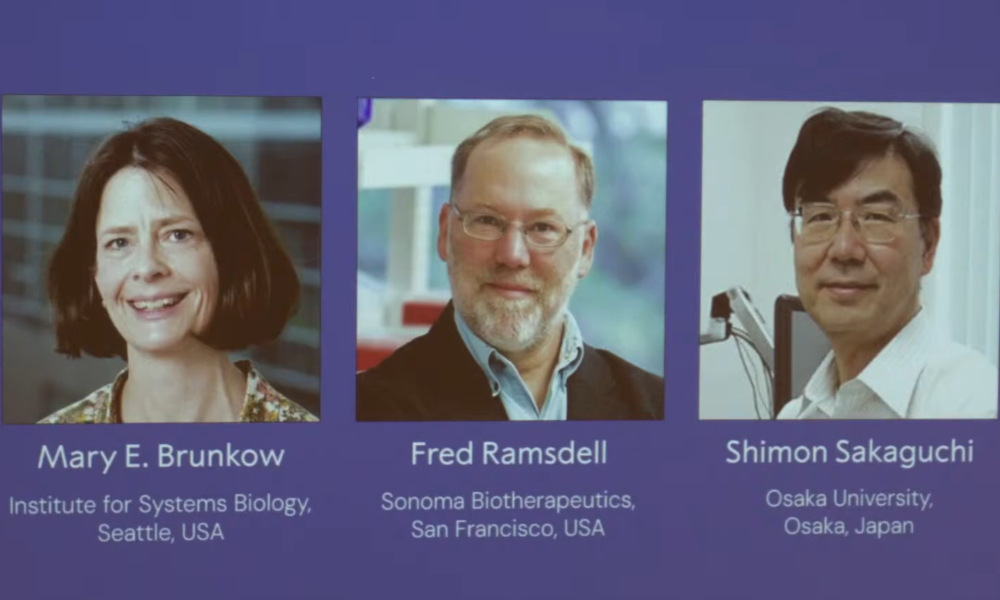
Mary E. Brunkow, Fred Ramsdell, and Shimon Sakaguchi have been awarded the 2025 Nobel Prize in Physiology or Medicine for discovering how the immune system learns to tolerate the body’s own cells, according to the Nobel Assembly at Karolinska Institutet.
The award was announced on Monday in Stockholm, Sweden. The Nobel Committee said the three scientists uncovered how the body prevents its powerful immune system from attacking its own organs, a process known as peripheral immune tolerance.
“Their discoveries have been decisive for our understanding of how the immune system functions and why we do not all develop serious autoimmune diseases,” said Olle Kämpe, chair of the Nobel Committee.
Sakaguchi made the first breakthrough in 1995, when he discovered a previously unknown type of immune cell that helps prevent autoimmune disease. These cells, now known as regulatory T cells, act as the body’s “security guards,” ensuring that the immune system does not harm healthy tissue.
Brunkow and Ramsdell made another major discovery in 2001 while studying a strain of mice prone to autoimmune diseases.
They found that the mice had a mutation in a gene called Foxp3 and later showed that mutations in the same gene can cause severe immune disorders in humans. Two years later, Sakaguchi proved that Foxp3 controls the development of regulatory T cells.
Their discoveries laid the foundation for new research and treatments for autoimmune diseases, cancer, and organ transplants.
Brunkow, born in 1961, is a Senior Program Manager at the Institute for Systems Biology in Seattle. Ramsdell, born in 1960, is a Scientific Advisor at Sonoma Biotherapeutics in San Francisco. Sakaguchi, born in 1951, is a Distinguished Professor at Osaka University’s Immunology Frontier Research Center in Japan.
The three will share the prize of 11 million Swedish kronor, or about $1 million.
The Nobel Peace Prize will be announced on Friday, October 10. Other prizes, including those for physics, chemistry, literature, and economics, will be awarded later this week.
The Nobel Prizes were established by Swedish inventor Alfred Nobel in 1895 to honor those whose work brings the greatest benefit to humanity. Each laureate receives a medal, a diploma, and a share of the prize money.


England beats France 6-4 to claim 3rd place at World Cup

Ontario premier calls Trump’s Canada wildfire tariff threat ‘unacceptable’

10 bodies found in Zacatecas, Mexico, including 5 hanging from bridge

Gulf system could become tropical depression near Florida
-

 Legal1 week ago
Man shot and killed by police after pointing gun at people in Austin, Texas
-

 World6 days ago
Death toll from wildfire in southern Spain rises to 13
-
 Politics5 days ago
U.S. sanctions 10 Cuban entities over repression and regime funding
-

 Legal4 days ago
Muslim mall worker critically injured in stabbing over his religion
-

 Legal4 days ago
New Mexico detective convicted of helping drug trafficker evade DEA operations
-

 Legal5 days ago
New York man arrested after livestreaming threats to kill Donald Trump Jr.
-
 Legal5 days ago
Austin police release footage of fatal shooting of man who pointed gun at bystanders
-

 World1 week ago
Shoe factory fire kills 28 people in China