
World
3 scientists win Nobel Prize in Chemistry for metal–organic frameworks

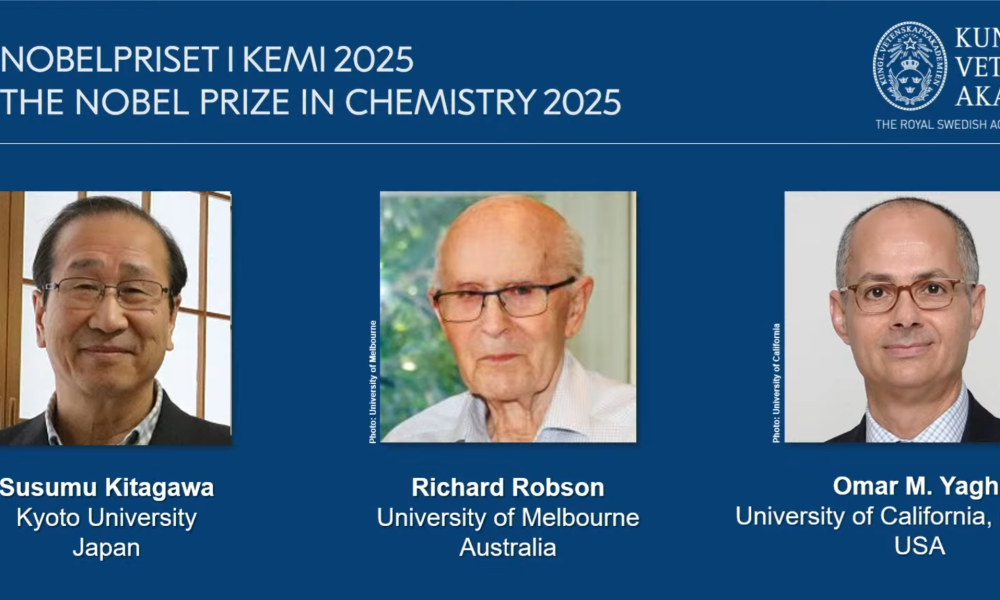
The 2025 Nobel Prize in Chemistry has been awarded to Susumu Kitagawa, Richard Robson, and Omar M. Yaghi for developing metal–organic frameworks, materials that can trap, store, and filter gases and other chemicals, according to the Royal Swedish Academy of Sciences.
The Academy said on Wednesday the three scientists created a new type of molecular structure with open, spacious frameworks that act like microscopic cages.
These materials, known as metal–organic frameworks (MOFs), can be designed to capture specific substances such as carbon dioxide or toxic gases, store clean energy, and even extract water from desert air.
“Metal–organic frameworks have enormous potential, bringing previously unforeseen opportunities for custom-made materials with new functions,” said Heiner Linke, chair of the Nobel Committee for Chemistry.
The discovery of MOFs began in 1989, when Richard Robson of the University of Melbourne built the first crystal-like framework by linking copper ions with organic molecules, forming a structure full of empty spaces. The idea was groundbreaking, but the material was unstable.
In the 1990s, Susumu Kitagawa of Kyoto University and Omar Yaghi of the University of California, Berkeley, made key advances to stabilize and improve the materials. Kitagawa demonstrated that gases could move through the frameworks, while Yaghi developed highly stable versions that could be fine-tuned for specific purposes.
Since then, scientists have created tens of thousands of MOFs with diverse applications, from capturing industrial emissions to filtering water contaminants. Researchers believe they could play an important role in addressing major environmental challenges, including climate change and water scarcity.
Kitagawa, born in 1951 in Kyoto, Japan, earned his Ph.D. from Kyoto University, where he is now a professor.
Robson, born in 1937 in Glusburn, United Kingdom, received his Ph.D. from the University of Oxford and teaches at the University of Melbourne.
Yaghi, born in 1965 in Amman, Jordan, earned his Ph.D. from the University of Illinois Urbana-Champaign and is a professor at the University of California, Berkeley.
The three laureates will share the prize of 11 million Swedish kronor (about $1 million).
Earlier this week, the Nobel Prize in Physiology or Medicine was awarded to Mary E. Brunkow, Fred Ramsdell, and Shimon Sakaguchi for discovering how the immune system learns to tolerate the body’s own cells.
The Nobel Prize in Literature will be announced on Thursday, followed by the Peace Prize on Friday and the Economics Prize on Monday.


NATO intern arrested in Belgium over suspected espionage

Armed man shot by police after Queens house explosion; 2 found dead inside

21 injured in 5-alarm fire in Queens, NYC

1 dead, 16 injured after van driver strikes attendants at Berlin pride parade
-

 World3 days ago
Houthis claim missile and drone attacks on 2 Saudi oil tankers in Red Sea
-

 Legal3 days ago
2 Indianapolis police officers shot during disturbance call
-

 Legal3 days ago
Puerto Rico man charged over threats to bomb White House, attack soldiers and Jewish people
-

 US News4 days ago
All 4 U.S. soldiers killed in Jordan and Iraq identified
-

 World4 days ago
Death toll from Guyana ferry disaster rises to 53
-

 World3 days ago
Journalist shot dead in Mexico after blaming state government for death threats
-

 Politics2 days ago
U.S. sanctions new CJNG leader, more than 50 people and companies
-

 World3 days ago
Mexican mayor shot dead inside city hall