
Reviews
Why Your Employee Onboarding Fails in the First 90 Days (And How to Fix It)

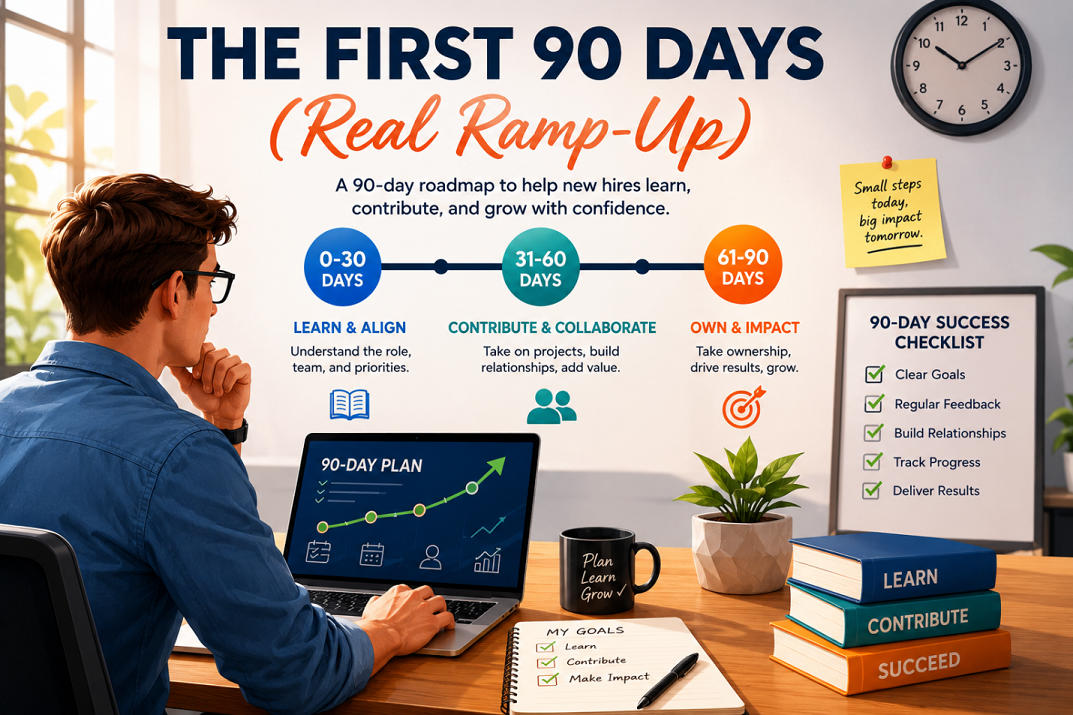
A new hire signs the offer letter, shows up on day one full of energy, and then… gets handed a 60-page PDF and a login that doesn’t work. Two weeks later, they’re quietly wondering if they made the right choice.
If that scene sounds familiar, you’re not alone. Most onboarding programs lose people in the first three months, not because the hire was wrong, but because the process was. This article is for HR leaders, L&D managers, and team leads who want new employees to feel confident and productive faster. You’ll learn where onboarding usually breaks down, what actually keeps people engaged, and a practical structure you can apply to your next hire.
What Onboarding Is Really Measuring
Onboarding isn’t a paperwork sprint. It’s the first real signal a new employee gets about how your company operates. Are things organized or chaotic? Do people communicate clearly or expect you to guess?
Research has consistently shown that employees who go through a structured onboarding process are far more likely to stay past their first year. The reason is simple: people want to feel useful and supported. When someone spends their first week unsure of who to ask for help, they start building a story in their head and it’s rarely a flattering one. Here’s the quickest way to tell if your onboarding is working: ask a 60-day hire to explain what your team actually does and how their role fits in. If they fumble the answer, the problem isn’t them.
The Three Stages Most Companies Skip
A lot of onboarding plans cover paperwork and tool access, then call it done. But the part that builds long-term commitment happens in the weeks after the welcome email fades.
Stage 1: Before Day One (Preboarding)
The gap between accepting an offer and starting work is dead time at most companies. Smart teams use it.
- Send equipment and login credentials early so nothing is broken on day one.
- Share a short welcome video from the team or manager.
- Give a simple agenda for the first week so the new hire knows what to expect.
A friend of mine started a job where her laptop arrived three days early, fully set up, with a handwritten note from her manager. She told me she felt loyal before she’d even clocked in. That’s the kind of small detail that costs almost nothing but pays off for years.
Stage 2: The First Week (Orientation Done Right)
The first week sets the tone. Cramming every policy, system, and acronym into five days guarantees overload. People can’t absorb that much at once, and they won’t.
Instead, focus on three things:
- Clarity of role: What does success look like in 30, 60, and 90 days?
- Human connection: Who are the people they’ll work with, and who do they go to with questions?
- A quick win: Give them one small, real task they can finish by Friday.
That quick win matters more than people realize. Finishing something tangible early gives a new hire proof that they belong and can contribute. It beats sitting through eight hours of slideshows.
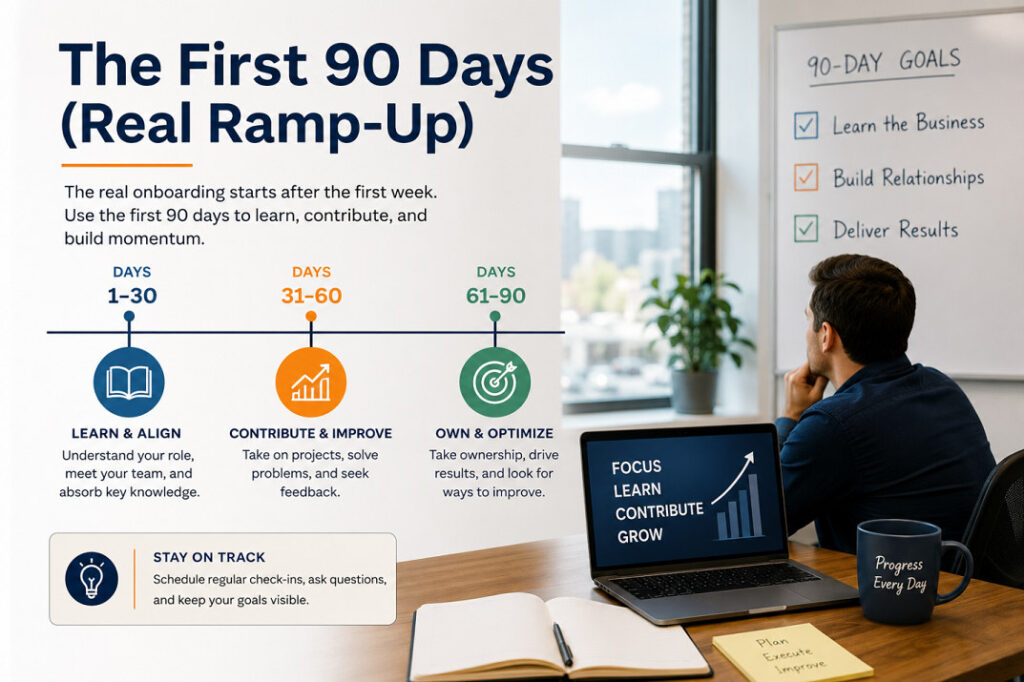
Stage 3: The First 90 Days (Real Ramp-Up)
This is the stage almost everyone neglects. Onboarding gets treated as a one-week event, then the new person is left to sink or swim. Set check-in points at week two, week six, and the 90-day mark. Use them to answer questions, correct course, and confirm the role still matches expectations on both sides.
Why Video Beats the Wall of Text
Most onboarding content is written, which makes sense for things like benefits forms or compliance policies. But for explaining how something works, video does the job better. People retain a demonstration far longer than a paragraph describing the same steps.
Think about how you’d rather learn a new software tool: reading a numbered list, or watching someone click through it while explaining what they’re doing? The video wins almost every time. This is why so many companies now build short, focused video lessons into their onboarding instead of relying on text-only manuals.
Producing good learning videos isn’t about flashy editing. It’s about clarity, pacing, and showing the right thing at the right moment. Some organizations handle this in-house, while others partner with specialists like the Blue Carrot company to turn dry training material into clear, watchable lessons that new hires actually finish. The format matters because attention is fragile; a confusing five-minute video gets abandoned just as fast as a confusing five-page document.
A few practical rules for onboarding video that works:
- Keep each video under five minutes and focus on one task or topic.
- Show the actual screen or process, not a talking head reading bullet points.
- Add captions, since plenty of people watch with the sound off.
Common Onboarding Mistakes (And Quick Fixes)
Even well-meaning teams trip over the same problems. Here are the ones I see most often.
- Mistake: Information dumping on day one.
Fix: Spread learning across the first month. Give people what they need when they need it, not everything at once. - Mistake: No clear owner.
Fix: Assign one person responsible for the new hire’s experience. When onboarding belongs to “everyone,” it belongs to no one, and things slip through. - Mistake: Treating onboarding as separate from the job.
Fix: Build learning into real work. Let people practice on actual tasks with a safety net, rather than rehearsing in a vacuum. - Mistake: No feedback loop.
Fix: Ask new hires what confused them. They’re the only ones who can see the gaps you’ve stopped noticing. A simple survey at 30 and 90 days surfaces problems you’d never catch otherwise.
If you’re stuck deciding where to start, fix the day-one experience first. It’s the cheapest change with the biggest emotional payoff.
Building a Simple Onboarding Framework
You don’t need expensive software to do this well. You need a plan and someone who owns it. Here’s a structure you can adapt this week.
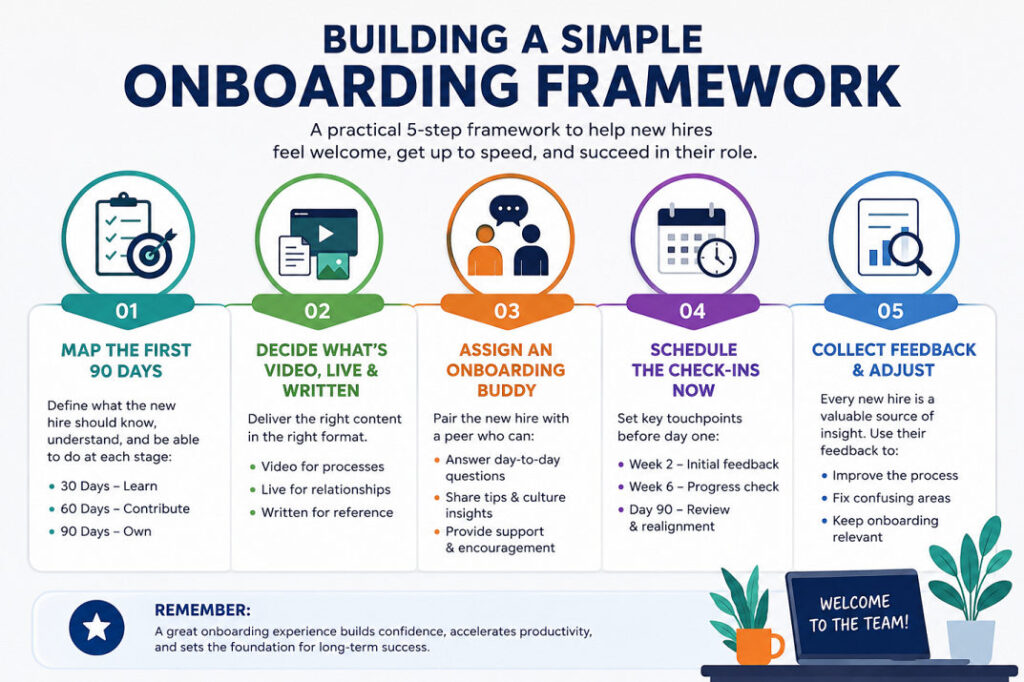
- Map the first 90 days. Write out what the new hire should know and be able to do at each checkpoint.
- Decide what’s video, what’s live, and what’s written. Use video for processes, live time for relationships, and documents for reference.
- Assign an onboarding buddy. A peer who answers the “small” questions people feel awkward asking a manager.
- Schedule the check-ins now. Put week two, week six, and day 90 on the calendar before the hire even starts.
- Collect feedback and adjust. Every new hire is a free audit of your process. Listen.
This works for a five-person startup and a five-thousand-person enterprise alike. The scale changes; the principles don’t.
What Good Onboarding Feels Like
When onboarding works, you can feel it. The new person asks sharper questions by week two. They contribute to meetings by week four. By the 90-day mark, they’re explaining the role to the next new hire. That progression isn’t luck, it’s the result of a process built around how people actually learn and settle in. Onboarding is the first promise you make to an employee about what working with you will be like. Keep it well, and you set the tone for everything that follows. Pick one stage from this article preboarding, the first week, or the 90-day ramp and improve it before your next hire starts. One focused change beats a complete overhaul you never finish.



-

 World5 days ago
5 injured in suspected anti-Muslim attacks in Scotland’s capital
-

 Business6 days ago
Ubisoft co-founder Claude Guillemot killed in France plane crash
-

 Legal1 week ago
2 men charged in separate threats to kill Trump
-

 US News1 week ago
Hot air balloon with 10 on board crashes in Nevada; several injured
-

 Legal1 week ago
Death penalty possible in White House National Guard shooting case
-

 Legal2 days ago
Texas Amber Alert: 14-year-old Audrey Rich abducted in Big Springs
-

 Legal3 days ago
6 killed in New York motel fire; man arrested on arson charges
-

 Legal3 days ago
2 more arrested in alleged plot to attack UFC event at White House