
Reviews
Seeing the Action from the Upper Tiers: OPPO Find X9 Ultra’s Long-Range Camera


From the upper tiers of any massive 40,000-seat stadium, athletes on the pitch remain incredibly distant, and standard smartphones typically reduce them to small, blurry figures. The OPPO Find X9 Ultra, launched in Vietnam in May 2026 as the ultimate flagship of OPPO’s Find X9 series and co-developed with Hasselblad, targets this specific problem: high-quality photography from real seating distances, not from front-row positions that come at a significant premium.
The Telephoto: How Far Is Actually Far
The Hasselblad 50MP 10× Ultra-Sensing Optical-Zoom Telephoto uses a Quintuple Prism Reflection Periscope Structure for a native 230mm f/3.5 focal length on a 1/2.75-inch sensor. From an upper tier at 80 meters from the pitch center, 10× optical zoom brings the subject to a working distance comparable to what sports photographers use with a 200mm lens on a full-frame body — close enough to isolate a player in motion rather than document the full scene.
The 20× optical-quality zoom extends the working range further through AI-enhanced pixel reconstruction. At 120× digital zoom, reading scoreboards and jersey numbers is what the system actually handles at that ceiling.
In stadium environments where floodlighting creates deceptive exposure challenges, the 1/2.75-inch f/3.5 sensor provides a distinct optical advantage. Floodlit pitch photography seems bright but varies significantly across zones — faster apertures gather more light per frame, which buys lower ISO or faster shutter speed when action photography requires it. Competing periscope configurations typically land at f/4.0.
200MP Crops: The Shot You Didn’t Know You Took
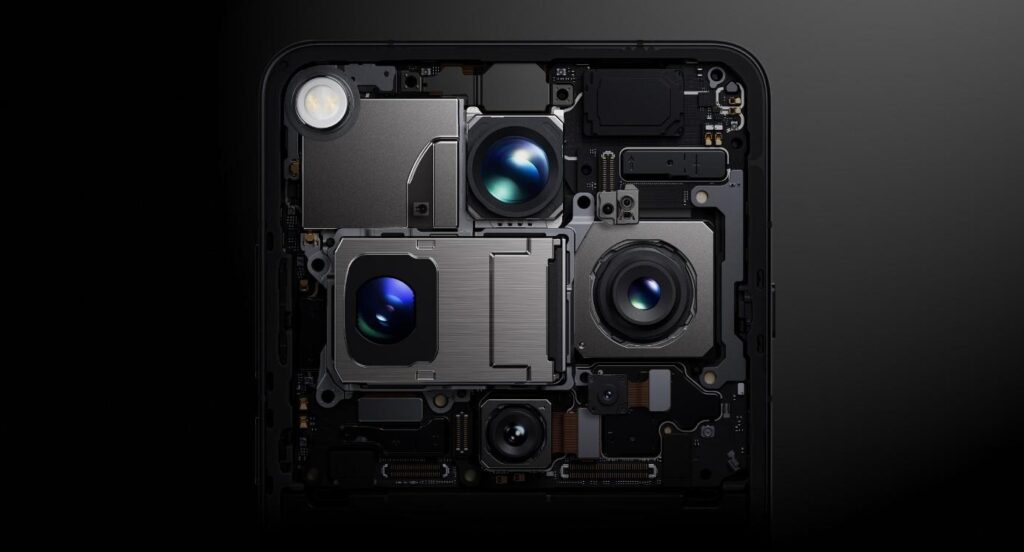
The dual 200MP cameras — 23mm main (1/1.12-inch sensor, f/1.5) and 70mm portrait telephoto (1/1.28-inch sensor, f/2.2) — produce files large enough to crop into specific sections after the fact. A wide 23mm capture of the full stadium during a decisive moment holds enough resolution to crop into the goal-scoring action with detail quality that approaches a deliberately composed telephoto shot.
OPPO builds the 200MP output through advanced multi-frame fusion rather than single-frame interpolation. At pixel-level inspection, the fusion approach produces cleaner results — particularly in the mid-tones where noise and color accuracy are most visible.
Compared to the Find X9s, which tops out at 50MP across all three cameras, the 200MP gap is meaningful for anyone who regularly crops into sports photographs after the fact.
Cinematic Slo-Mo: 4K 120fps Dolby Vision
Recording a sudden goal celebration or a frenetic concert crowd in 4K 120fps Dolby Vision allows the action to be slowed down to a quarter of its original speed without sacrificing the format’s extended tonal range. Stadium lighting — bright LED floodlights over a dark surrounding environment — is the high-contrast scenario where Dolby Vision’s wider dynamic range handles both highlight detail and shadow texture simultaneously, where standard HDR video clips one or the other.
The Snapdragon 8 Elite Gen 5 runs sustained 4K 120fps without the frame-rate drops that appear on less capable chips during extended recording. The 3D Cryo-velocity Cooling System manages the thermal load, which matters for multi-song concert sets or full-match video capture.
4K HDR Motion Photo at Live Events
Live events are unpredictable. The decisive moment passes in under a second, and single-frame timing is a gamble. 4K HDR Motion Photo captures a continuous 4K HDR buffer around each still frame, across focal lengths from 0.6× to 10×. The result: the full sequence leading into and out of the key moment is captured, and the specific frame gets selected after the fact rather than bet on during the event.
The 4K HDR quality means the selected still from a Motion Photo competes with a deliberately framed still capture. Because these extracted stills retain 4K HDR quality, users no longer need to perfectly anticipate the action; they can simply capture the sequence and pull a cleanly framed shot afterward.
Network in a 40,000-Person Crowd
My Dinh at capacity is among the most network-congested environments in Vietnam. Tens of thousands of simultaneous uploads at peak moments degrade shared cell infrastructure quickly. The NetworkBoost Chip S1 adapts in real time to congested network conditions, and OPPO’s connectivity documentation specifically cites concert and crowded venue scenarios.
The 360° Surround Antenna Architecture maintains consistent signal reception regardless of how the phone is physically oriented — removed grip-based signal loss that affects devices with conventional antenna placement.When tens of thousands of attendees attempt to post match highlights simultaneously, this active signal management often determines whether a video uploads instantly or stalls completely.
Other specs:
- Ultra-level Bionic Haptic Motor: Physical resonance feedback during music playback on-device.
- Ultra-level Symmetrical Speakers: Consistent stereo separation in any orientation, with 4-microphone audio capture for recording.
- 7050mAh battery: Full-match or full-concert duration without recharging.
- 144Hz 2K ProXDR Display: 3600 nits peak brightness for screen-reviewing shots in bright outdoor venues.


Ex-Navy SEAL sentenced for plot to attack police at ‘No Kings’ protests

Wife of Chiefs coordinator Eric Bieniemy shot by son in Virginia

Mitch McConnell remains in rehab, not medically cleared to return to Senate

Hurricane Genevieve becomes first Category 5 storm in eastern Pacific since 2024
-
 Legal2 days ago
Couple identified after family of 8 found dead in suspected Michigan murder-suicide
-

 World3 days ago
NATO intern arrested in Belgium over suspected espionage
-

 World6 days ago
Houthis claim missile and drone attacks on 2 Saudi oil tankers in Red Sea
-

 Politics5 days ago
U.S. sanctions new CJNG leader, more than 50 people and companies
-

 US News7 days ago
All 4 U.S. soldiers killed in Jordan and Iraq identified
-

 World7 days ago
Death toll from Guyana ferry disaster rises to 53
-

 Legal6 days ago
2 Indianapolis police officers shot during disturbance call
-

 Legal6 days ago
Puerto Rico man charged over threats to bomb White House, attack soldiers and Jewish people