
Reviews
The New Productivity Edge: Why Teams Are Turning to Unified Check-In Systems

If you’ve ever tried to piece together what a team achieved in a given week, you’ll know it isn’t the work that’s confusing, it’s the trail it leaves behind. Someone mentions progress during a call, someone else shares a note in passing, and a third person updates a metric tied to an OKR without saying much about it. By the time Friday shows up, the story exists, but you have to go digging for it.
That gap isn’t dramatic, but it’s persistent. And as teams lean more into async habits, the distance between “something happened” and “everyone knows it happened” keeps stretching. People aren’t less committed; they’re just operating in spaces where information slips out of view unless you build a way to hold it together, especially when goals and outcomes are meant to stay visible through an OKR framework.
The Shift: Why Unified Check-Ins Are Becoming Operational Infrastructure
The more hybrid and distributed a team becomes, the more scattered its reporting gets. It’s not unusual for a simple weekly update to be split across slides, Notion pages, email chains, and three unrelated tools. That fragmentation creates a quiet tax: progress stalls, or at least slows to a crawl.
Unified check-ins are emerging as a new operational baseline for precisely this reason. When OKRs anchor the work, the updates that describe that work need a single place to land. Marketing teams want one home for campaign KRs. Product teams want one home for delivery milestones. Operations teams want one home for KPIs that tie back to strategic objectives. The pattern is the same across industries: fewer tools, more coherent signals, faster decisions.
Oboard’s Answer: A Central Check-In Feed Built for Real-World Workflows
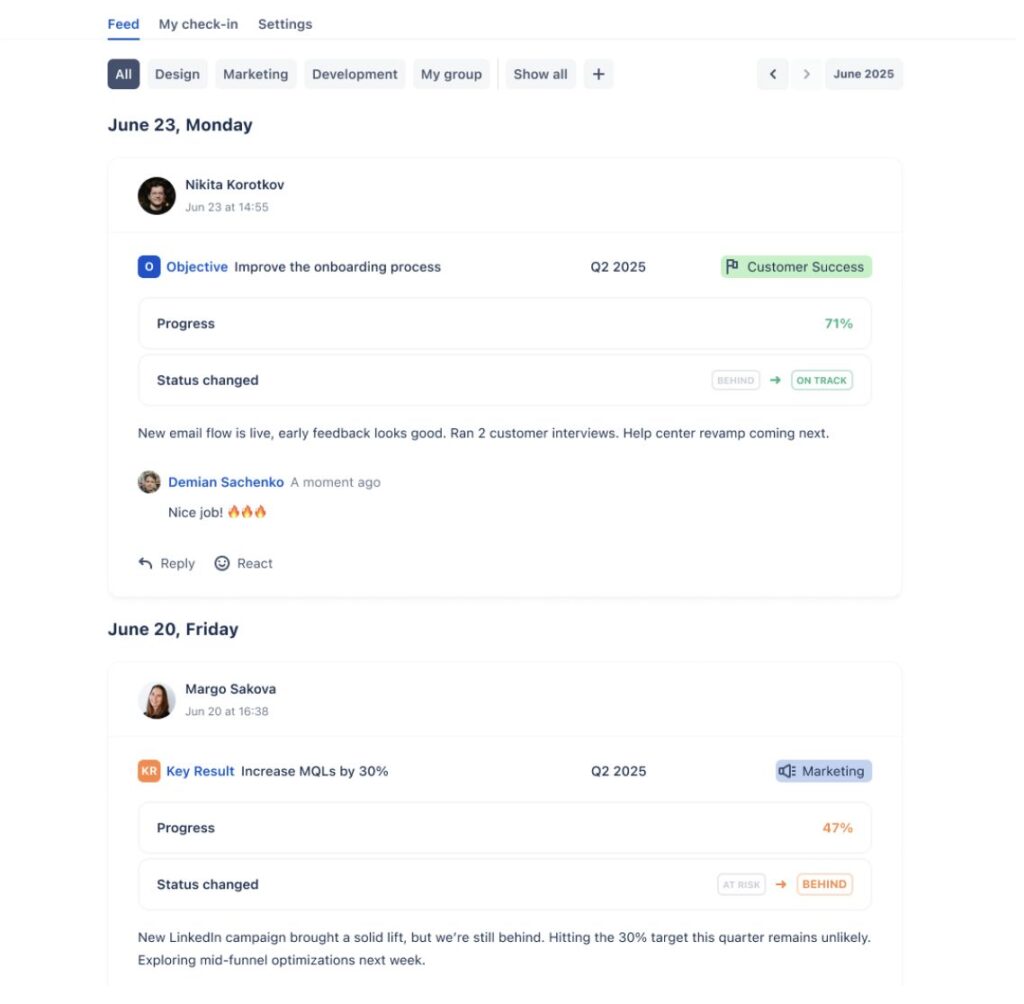
Oboard OKR Software latest update is built directly around this shift, turning check-ins into a structured layer that sits on top of OKRs and KPIs without asking teams to change the way they work. Instead of hunting through different screens or tools, progress now flows into a single shared feed.
A few things make the difference:
- A unified feed for every OKR and KPI update
Everything related to goals — outcomes, metrics, weekly movements — appears in one chronological view. It’s easier to see what advanced, what stalled, and what needs attention next. - History that stays where the work happens
When someone submits a check-in, they can immediately see the previous one in the same window. A longer history sits right below the objective or metric it belongs to, creating a continuous narrative rather than scattered fragments. - Automatic status signals that add context
Updates automatically receive a status (on track, behind, at risk), giving teams a quick read before diving deeper. - A better way to have async conversations
Anyone can reply directly to a check-in to ask a question or point out something important. It keeps the discussion close to the goal it’s related to. - Reminders that run quietly in the background
Weekly, biweekly, monthly, or custom reminders can go out through Slack, Microsoft Teams, Discord, email, or in-app notifications — reducing the soft overhead of tracking down missing updates.
All of this creates a rhythm in which check-ins aren’t interruptions. They simply become part of how OKRs stay alive over the quarter.
Faster Decisions, Fewer Meetings, Clearer Accountability
When teams can see progress without hunting for it, the work moves more smoothly. Unified check-ins make that possible. They give async teams a steady way to stay aligned, so momentum doesn’t depend on reminders, meetings, or scattered reports. For most organizations working this way, that level of clarity has become less of a convenience and more of a baseline.
And this is the space Oboard is leaning into: building a check-in system that doesn’t compete with the OKR process, but strengthens it. For teams trying to stay aligned without slowing down, that kind of connection between daily activity and strategic objectives is starting to feel less like a feature and more like the thing that keeps everything else running.


Australia implements ban on social media accounts for users under 16

Nearly 50 new measles cases reported amid outbreaks in Arizona and South Carolina

22 killed in fire at drone company office in Jakarta, Indonesia

18-wheeler carrying sulfuric acid catches fire on I-610 in Houston
-
 Health7 days ago
France confirms 2 MERS coronavirus cases in returning travelers
-

 Health1 week ago
8 kittens die of H5N1 bird flu in the Netherlands
-
 US News4 days ago
Magnitude 7.0 earthquake strikes near Alaska–Canada border
-
 Entertainment7 days ago
Joey Valence & Brae criticize DHS over unauthorized use of their music
-

 US News1 week ago
Fire breaks out at Raleigh Convention Center in North Carolina
-

 Legal6 days ago
Woman detained after firing gun outside Los Angeles County Museum of Art
-

 Legal1 day ago
Shooting at Kentucky State University leaves 1 dead and another critically injured
-
 Health1 week ago
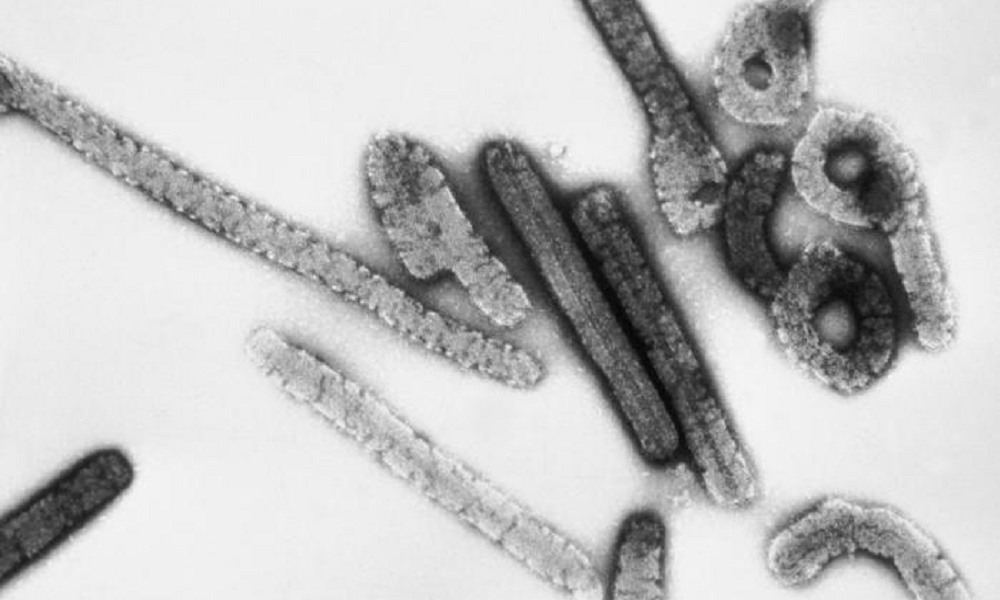
Ethiopia reports new case in Marburg virus outbreak